Retaining Walls Gold Coast: Council Approval, Cost & Materials Guide
Retaining walls are the single most under-explained part of landscaping. Owners know they need one when their yard slopes — but the moment a quote arrives, prices vary wildly, council rules feel impossible to navigate, and material choices look like they only matter to the tradie. So most homeowners just pick the cheapest option, hope for the best, and end up replacing the wall in seven years.
Retaining walls are one of the most technical parts of landscaping — and one of the easiest places to get a quote that hides what really matters. This guide covers everything worth understanding before you build one on the Gold Coast: when council approval kicks in, what the real cost breakdown looks like, which materials hold up in our climate, and the drainage detail that decides whether a wall lasts decades or fails in a few wet seasons.
When does Gold Coast Council require approval?
The rule most people quote — “walls under a metre don't need approval” — is correct, but only as a starting point. The full answer is:
- Height threshold:Retaining walls 1 metre or less in retained height (measured from the toe of the wall to the top of the retained earth) are generally exempt from a Building Approval under Gold Coast City Council's Building Regulation 2021.
- Boundary setbacks: Walls within 1.5 metres of a boundary — regardless of height — require council approval if they affect neighbouring land or fencing arrangements.
- Surcharge zones: Walls near driveways, parking pads, or any area that puts an additional load on the retained earth need engineered design even at lower heights.
- Combined heights: Two walls stacked or terraced together — for example, two 800mm walls — are usually treated as a single wall by council. Two 800mm walls = 1.6m of effective retention = needs approval.
On every Lux job we figure out which side of the line your wall falls on during the quoting phase. If approval is needed we handle the engineering brief, lodgement, and certifier coordination — and we make that visible in the quote so you can see exactly what the council component costs. Read more about how this sits inside our process on the hardscaping & retaining walls page.
What does a retaining wall actually cost on the Gold Coast?
Pricing varies more than almost any other landscaping job because the labour-to-material ratio shifts dramatically with site conditions. Here's the breakdown that drives the price when scoping a wall:
Treated timber or concrete sleeper
$250–$450 per square metre installed. The cheapest entry point. Treated pine sleepers (H4 timber) or concrete sleepers slotted between galvanised steel posts. Best for: garden borders, low retaining (under 800mm), and budget-conscious projects on hinterland blocks where moisture exposure is moderate. Honest lifespan: 15–20 years on treated timber, 30+ on concrete sleepers.
Sandstone block
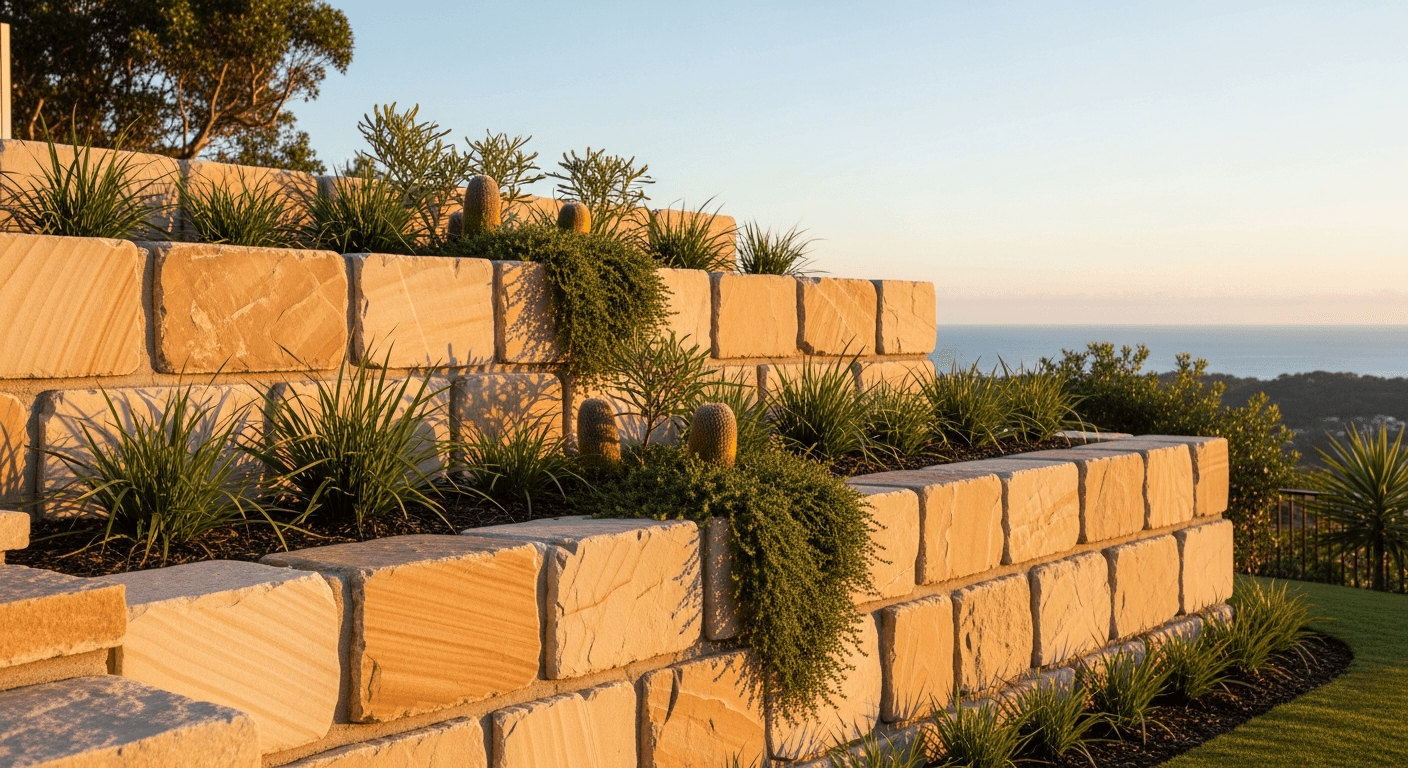
$500–$800 per square metre installed.The Gold Coast classic. Cut sandstone blocks (Helidon, Pyrmont, or local source) stacked and pinned with engineered backfill. Looks better with age, doesn't move with seasonal soil shift, and handles salt exposure. Best for: feature walls, walls 600mm- 1.5m, properties where appearance matters as much as function.
Engineered concrete or natural stone (over 1.5m)
$700–$1,200+ per square metre installed. Anything over 1.5m legally requires engineered design, deeper footings, and structural backfill. Concrete-block-and-fill (besser-style with steel reinforcement and concrete core) or natural stone walls. Best for: hillside builds in Tallai, Mudgeeraba, Burleigh Hills, or any property with significant level change.
The biggest variables aren't the materials — they're site access (can a bobcat get in, or are we wheelbarrowing everything?), excavation depth (how much footing engineering do we need?), and drainage requirements (do we need a sock drain to a stormwater connection 15 metres away?). Steep sites in suburbs like Mudgeeraba, Burleigh Heads, and Currumbin typically sit at the high end of the per-square-metre range because access is constrained.
What material works best in the Gold Coast climate?
Three forces destroy retaining walls on the Coast: moisture (wet-season hydrostatic pressure), salt (corrosive within 3km of the coast), and soil movement(sub-tropical clay swells in wet, shrinks in dry, and shifts walls that aren't engineered for it). Material choice should track to which of those three is dominant on your site.
- Canal-front, beachside, anywhere within 3km of saltwater: Sandstone, natural stone, or concrete-block with stainless-steel fixings. Avoid raw steel and unsealed besser blocks. Suburbs: Surfers Paradise, Main Beach, Palm Beach, Broadbeach.
- Hinterland, sloping blocks, hilly terrain: Engineered sandstone or natural stone walls with deep footings. Soil movement and rainfall run-off are the killers here. Suburbs: Mudgeeraba, Currumbin, and the Burleigh Hill parts of Burleigh Heads.
- Flat suburban blocks (most central Gold Coast): Concrete sleeper or sandstone block both work well. Drainage matters more than material here. Suburbs: Robina, Bundall, Varsity Lakes, Merrimac.
The drainage detail nobody talks about
Here's the single most important fact about retaining walls on the Gold Coast: hydrostatic pressure failure outnumbers structural failure ten to one.When water pools behind a wall — because there's no drainage, or the drainage isn't connected — the soil swells, the wall bulges, blocks crack, and within a few wet seasons the whole thing has to come down.
Proper drainage isn't complicated. It just isn't free. On every Lux retaining wall:
- A geo-fabric layer sits against the back of the wall to prevent fine soil from washing into the aggregate.
- A 20mm aggregate backfill sits behind the geo-fabric, providing free water flow path.
- A 65mm slotted PVC ag drain(often called “sock drain” because it's wrapped in geo-fabric sleeve) runs along the base of the aggregate, sloped 1:100 to a stormwater outlet.
- The outlet either connects to council stormwater, a soak well, or daylights to a safe overflow point at least 3 metres from any structure.
That whole stack adds maybe 8–12% to the wall cost. Skipping it saves you maybe $400 on a $5,000 wall. Five years later, that's a $7,000 repair. It's the worst trade in landscaping.
Common Gold Coast retaining wall mistakes
The most common ways Gold Coast retaining walls go wrong — usually because a corner was cut somewhere that wasn't visible at handover:
- Stacking walls in “steps” to dodge approvals. Two 950mm walls 200mm apart still counts as a 1.9m retained height to council. Doing this without engineering is structurally risky and council will issue an enforcement notice if it gets reported.
- Using unsealed besser blocks within 3km of the coast. Saltwater wicks through the porous block face within 2–3 years; the steel inside corrodes; the wall fails from the inside out.
- Skipping the ag drain.Some installers think geo-fabric + aggregate is enough. It's not — water still pools at the base of the aggregate column without a pipe to carry it away.
- Not lodging council approvals. Walls built without approval are invisible until you sell the property — then the building inspector flags them and the buyer either renegotiates or walks away.
How to get a real quote on a Gold Coast retaining wall
A trustworthy retaining wall quote shows you, at minimum:
- Total square metres of retention (height × length).
- Material spec by name (not “sleepers” — “H4 treated 200×75 pine sleepers, 2.4m galvanised steel C-channel posts at 1.2m centres”).
- Drainage spec (sock drain, aggregate volume, outlet path).
- Whether engineering / certification is included, and at what cost.
- Council application fees, separately itemised.
- Excavation and disposal cost (assume 20% of the wall volume becomes spoil to be removed).
If a quote just says “Retaining wall — $4,500” with no breakdown, ask for the itemised version. If they won't provide one, that's your answer.
Quick start
If you've got a slope you're wrestling with — small garden bed or full hillside terrace — we'll do the site visit and quoting at no cost. You'll get a clear breakdown of which materials suit your block, what council approval will look like, and a fixed-price quote with no surprises at handover. Reach out via the contact page or call 0485 032 685.
Frequently asked
Common questions.
Do I need council approval for a retaining wall on the Gold Coast?
Under Gold Coast City Council rules, retaining walls 1 metre or less in height typically don't need approval — provided they're not within 1.5 metres of a boundary, not retaining surcharge from a vehicle area, and not part of a regulated infrastructure setback. Anything over 1 metre, or any wall in those special zones, needs building approval and a certifying engineer's design. We handle the paperwork for you on every Lux job over the threshold.
How much does a retaining wall cost on the Gold Coast?
Expect roughly $250–$450 per square metre for treated timber or concrete sleeper walls, $500–$800 per square metre for sandstone block, and $700–$1,200+ per square metre for engineered concrete or natural stone walls over 1.5m. The bigger variables are site access, drainage requirements, and whether you need an engineer's certification. We provide a fully itemised quote after assessing the site.
What's the best material for a retaining wall in the Gold Coast climate?
Sandstone is the gold standard — it doesn't move with seasonal soil shift, weathers beautifully, and handles the salt + humidity. For canal-front or beachside sites we specify sandstone or stainless-fixed concrete blocks; for hinterland sites timber works well at smaller heights. We avoid raw steel within 3 km of the coast (it corrodes within years) and recommend against unsealed besser blocks anywhere — they wick moisture and fail early.
How long does a retaining wall take to build?
A small wall (under 10 sqm, no engineer required) takes 3–5 days including drainage. A medium engineered wall (10–30 sqm) usually takes 1–3 weeks including approvals. Larger or complex sites with terracing can run 4–6 weeks. The biggest variable is council approval timing — we lodge the day we sign so we lose no time at the front end.
What's the difference between a retaining wall and a feature wall?
A retaining wall holds back earth — it's a structural element with engineered drainage, footings, and load calculations. A feature wall is purely decorative — it stands on its own, doesn't retain soil, and doesn't need the same engineering. Many Gold Coast homes have both; we'll be clear during quoting which is which.
Do I need drainage behind my retaining wall?
Always. Hydrostatic pressure (water building up behind a wall) is the single biggest cause of wall failure on the Gold Coast — especially after wet-season storms. Every Lux retaining wall includes an aggregate drainage layer, geo-fabric, and a 65mm slotted PVC ag drain piped to a stormwater outlet. The drainage is invisible once finished, but it's what makes the wall outlive the next 30 wet seasons.
Written by
Riley Penn
Founder, Lux Landscaping
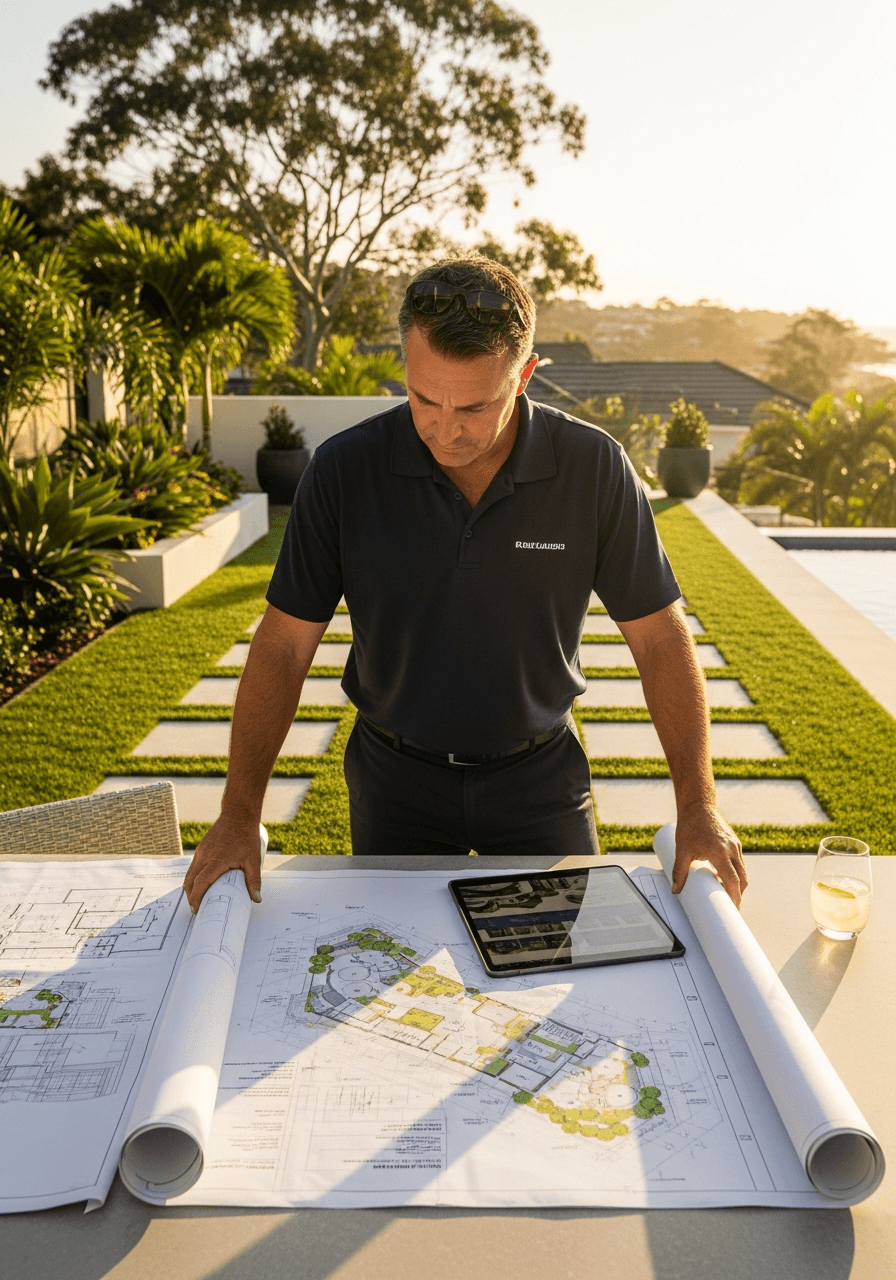
Riley is the founder of Lux Landscaping, Cert III qualified in Landscape Construction and QBCC licensed on the Gold Coast. Every Lux quote and consultation comes through him personally — and these guides are written to share what he's learned about doing landscaping properly in the Gold Coast climate.
More from the Lux blog
Keep reading.

Ready to start?
Let's talk about your project.
Free site visit. Detailed itemised quote within 24 hours. Reach Riley directly.